
Your Singapore private company does not automatically need a public accountant just to prepare its accounts. The real question is usually whether your small company meets Singapore's audit exemption, and who is the right person for each layer of work. Who can prepare unaudited financial statements in Singapore is really three questions rolled into one:
- Who may compile the pack
- Whether your company is exempt from audit at all
- What then has to be lodged with the regulators
For most small companies, the audit exemption is what makes an unaudited pack possible in the first place. But being exempt from an audit is not the same as being free of duties. The directors stay legally responsible for the statements, the records behind them and the filings that follow.
Getting this wrong is expensive in both directions. Some founders pay for assurance nobody required. That misstep is easy for a young startup to make when it faces its first Singapore year end. Others file late or with statements that do not meet the applicable framework. That risk grows when the accounts cover novel items, so it is worth checking the accounting treatment for DAO tokens well before year end. They assumed a bookkeeper's output was the finished product.
In this blog, we explain the full year-end path:
- Who may compile unaudited statements
- How the small company and exempt private company tests actually work
- What an SSRS 4410 compilation engagement covers
- When you need an auditor instead
- How the pack feeds your ACRA annual return and IRAS tax filing
Table of Contents
Who may prepare your Singapore company’s year-end accounts?
In most cases, the company's own management or an external accounting provider can prepare the pack. Singapore law does not generally require a registered public accountant for the ordinary preparation of unaudited statements. That is our reading of the current guidance, and it is general information rather than legal advice. We have gathered the related frameworks, checklists and guidance in our resources library. A specific engagement can carry licensing, professional-body or contractual requirements that need checking for your company's situation.
The Accounting and Corporate Regulatory Authority (ACRA) expressly allows directors to outsource record-keeping and the preparation of financial statements. The same guidance is clear that the directors stay legally responsible for the statements. Outsourcing lightens the workload, never the duty. Delegating the right tasks to the right people is just as central to how to build a successful startup team.
It helps to keep four services apart:
- Bookkeeping — recording daily transactions in cloud software such as Xero.
- Compilation — assembling the year-end statements from the final ledger.
- Review — a limited assurance engagement by a practising accountant.
- Audit — an independent examination ending in a formal opinion.
Only the review and audit involve assurance. Where written law requires an audit, that work must be carried out by a registered public accountant or audit practice. A bookkeeping or compilation service cannot substitute for it. Preparation, compilation, review and audit remain distinct services.
In practice, founders often assume an audit firm must touch the accounts every year. For a company that meets the exemption tests, the more common pattern is daily bookkeeping plus an outsourced year-end compilation of financial statements. That work can be taken off the founder's desk and is coordinated online with the client's own company secretary.
Does exempt private company status automatically exempt you from audit?
No — the label alone does not switch the audit off. An exempt private company (EPC) is generally a private company with fewer than 20 members and no corporation holding a beneficial interest in its shares, although a Government-owned private company declared an EPC by Gazette can also qualify. Current ACRA guidance says expressly that a company need not be an EPC to qualify for audit exemption. The test must be run on its own terms rather than on the EPC label.
For a private company, the usual route is the small company test: you generally must meet at least two of three thresholds for the immediately preceding two consecutive financial years. Newly incorporated companies follow special rules for their first and second financial years, so year one is not judged identically to later years.
If your company sits inside a group, the picture widens. A subsidiary must itself qualify as a small company, and the entire group — including foreign entities where applicable — must meet the quantitative test on a consolidated basis. Group status is determined under the applicable accounting standards and the facts, so a corporate shareholder does not automatically create a group.
Separately, a dormant company may be relieved from preparing statements under section 201A of the Companies Act, but only if the conditions in the law are met. Dormant relief is conditional, so it should be checked for the particular company rather than assumed.
Small Company Audit Exemption Thresholds in Singapore
| Test | Threshold (current rules) |
|---|---|
| Annual revenue | S$10 million or less |
| Total assets | S$10 million or less |
| Full-time employees | 50 or fewer |
| Qualifying condition | Meet at least two of the three thresholds for the immediately preceding two consecutive financial years |
| Newly incorporated companies | Special rules apply for the first and second financial years |
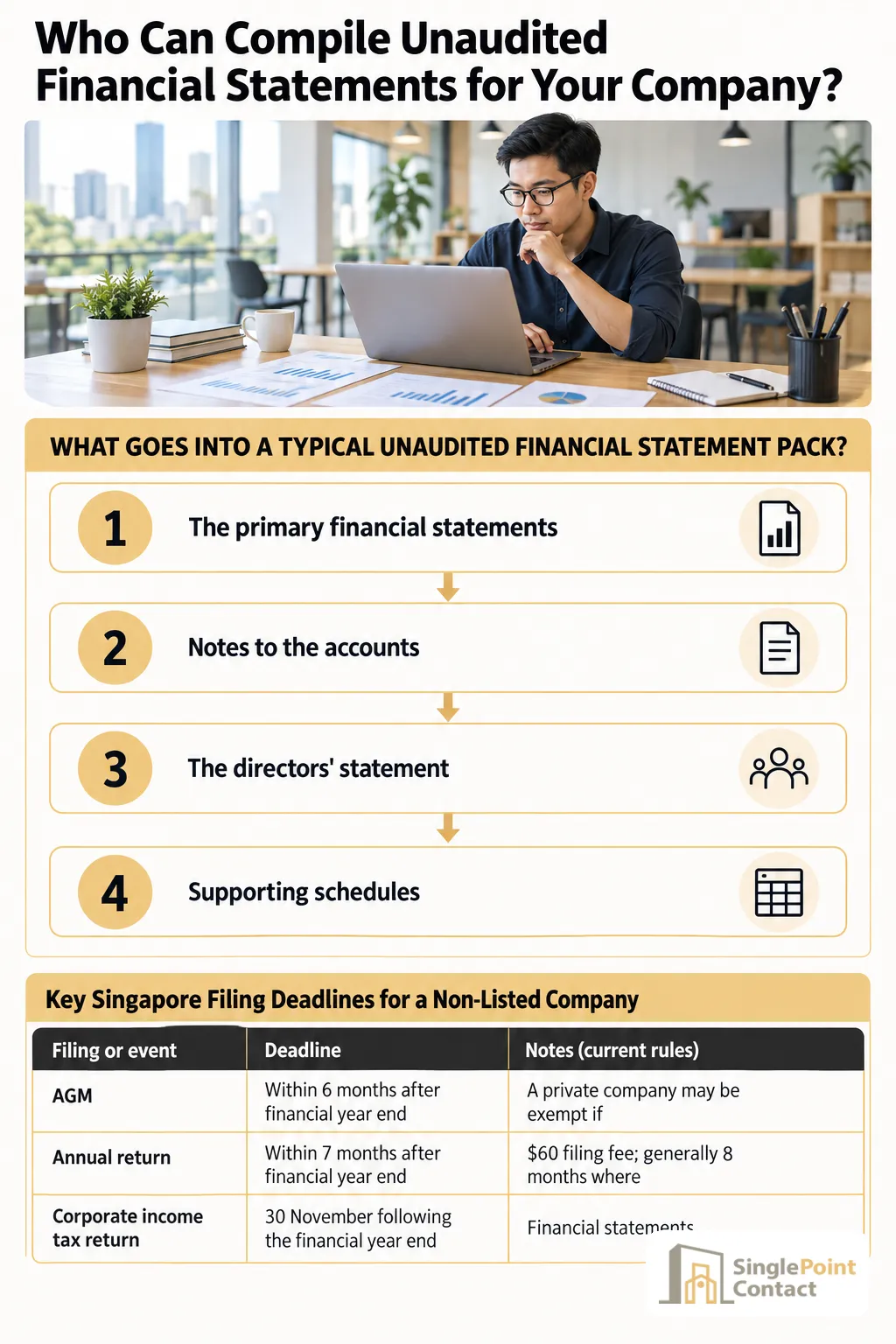
What goes into a typical unaudited financial statement pack?
An unaudited pack is slimmer than an audited one, but it is still a proper set of accounts. The exact contents depend on the reporting rules that apply to your company and its circumstances, so treat the outline below as an illustration rather than a universal template.
1. The primary financial statements
Normally the statement of profit or loss, the statement of financial position and the statement of changes in equity. A cash-flow statement is included where the framework requires it — whether one is needed depends on the applicable standards and any valid relief, so there is no general omission rule.
2. Notes to the accounts
Accounting policies, key estimates and the disclosures the framework calls for. These carry the substance of the statements, so vague notes undermine the pack.
3. The directors' statement
The formal statement the board approves. The directors, not the preparer, own this — approving it is a director duty, not a formality outsourced with the bookkeeping.
4. Supporting schedules
Lead schedules, reconciliations and workings kept as management papers behind each number. ACRA requires accounting records to be kept for at least five years after the relevant financial year, and to be good enough to support true and fair statements.
What is an SSRS 4410 compilation engagement?
SSRS 4410 (Revised) sits under the Singapore Standards on Related Services and governs compilation engagements. Its key feature is what it does not do: a compilation is not an assurance engagement. The practitioner assembles the statements using information supplied by management, is not required to verify its accuracy or completeness, and expresses no audit opinion or review conclusion.
Management retains responsibility for the financial information and for the accounting policies and estimates used to prepare and present it. The standard also sits within professional-practice signing conventions — who may sign an SSRS report depends on the signer's status as a professional accountant in public practice or a public accountant.
Whether your pack carries an SSRS 4410 report at all depends on the engagement terms. Ordinary preparation of unaudited statements does not automatically produce one. Some lenders and investors ask for a formally reported compilation. If that matters, ask your provider to confirm in writing that the engagement will follow the standard. Also ask who will sign it.
When do you need an auditor instead of a compiler?
Escalation to an auditor usually comes down to one of three triggers. The guide below reflects general practice — it is a decision framework, not one firm's fixed protocol, so weigh it against your own facts.
1. Your company does not qualify for the audit exemption
If the small company test or the group conditions fail, the statements must be audited. The audit and reporting function must be carried out by a registered public accountant or audit practice.
2. A third party requires independent assurance
Bank covenants, investors, grant bodies or regulators can require audited or reviewed accounts even where the statutory exemption applies. Those are contractual or sector requirements, and they sit outside the audit exemption.
3. The facts are genuinely complex
Group restructurings, tricky valuations or uncertain accounting treatments can make an audit or a specialist assessment appropriate even when the law does not force one.
How do unaudited statements fit your ACRA and IRAS filings?
The pack feeds two separate compliance tracks — ACRA's annual return and IRAS's corporate income tax return — and neither substitutes for the other.
On the corporate side, a non-listed company generally must hold its annual general meeting (AGM) within six months of financial year end, unless it is exempt or has validly dispensed with one. A private company may be exempt from holding an AGM if it sends financial statements to all members within five months of year end. But members, or an auditor where one is appointed, can still request a meeting, so the exemption is not unconditional.
The annual return then falls due within seven months of financial year end for a non-listed company. The exception is a company with share capital that keeps an overseas branch register — that company generally has eight months. ACRA's steps to file an annual return page lists the current $60 filing fee, and records update immediately on successful submission.
Whether statements must be filed at all depends on the company. A solvent EPC may be exempt from filing financial statements with ACRA. It must still make the solvency and audit-exemption declarations in the return. Not every EPC qualifies, so the status needs checking each year. Where statements are filed, the XBRL or PDF combination depends on company type: smaller, non-publicly accountable companies generally file simplified XBRL plus a directors-authorised PDF, while others file full XBRL. Note that filed statements become publicly purchasable.
On the tax side, IRAS requires companies to prepare financial statements, tax computations and supporting documents before filing. Form C-S and Form C-S (Lite) filers retain those documents unless IRAS requests them. Form C filers submit relevant documents subject to IRAS rules. The corporate return is due by 30 November following the financial year end on IRAS's due dates calendar.
The division of labour at year end is usually straightforward. Your company secretary handles registers, resolutions and the filing mechanics. The appointed secretary determines those steps. Your preparer drafts the accounts. Financial statement compilation sits with your preparer. Our guide on who does what during your Singapore year end close maps the full hand-off.
Key Singapore Filing Deadlines for a Non-Listed Company
| Filing or event | Deadline | Notes (current rules) |
|---|---|---|
| AGM | Within 6 months after financial year end | A private company may be exempt if statements reach members within 5 months; members or an auditor can still request a meeting |
| Annual return | Within 7 months after financial year end | $60 filing fee; generally 8 months where an overseas branch register is kept |
| Corporate income tax return | 30 November following the financial year end | Financial statements, tax computations and supporting documents prepared first |
Who Does What at Your Singapore Year End
| Role | Typical responsibility |
|---|---|
| Directors | Approve the statements and own the records, policies, estimates and the true and fair view — legally responsible even when work is outsourced |
| Bookkeeper or in-house team | Keep daily records reconciled in Xero throughout the year |
| Compilation provider | Draft the year-end statements, notes and supporting schedules from the final ledger |
| Company secretary | Statutory registers, resolutions and the annual return mechanics — the appointed secretary determines the steps |
| Auditor, where required | Independent audit scope and opinion; cannot be replaced by a compilation service |
What should you have ready before the year-end compilation?
Year-end delays often arise from missing paperwork rather than drafting. The checklist below covers ledgers, bank records, GST and tax reconciliations, including input tax where relevant.
An example year-end checklist includes:
- A final reconciled ledger, with the trial balance tied to bank and payment accounts
- Bank and payment-account statements or confirmations for the year
- Balance schedules for receivables, payables, fixed assets and loans
- Payroll reconciliations for the year
- GST and tax reconciliations, including input tax where relevant
- Related-party information, contracts and management confirmations for key estimates
Treat this as an illustration, not a complete list. Each company has its own information gaps. Keeping records current throughout the year can make the close easier.
Conclusion
Who can prepare unaudited financial statements in Singapore depends on the work involved. Management or an external provider may prepare an audit-exempt company's statements. Directors remain legally responsible for them.
An auditor is needed when the audit exemption is unavailable. Independent assurance may also be required by a lender, investor, regulator or contract.
Before appointing a provider, confirm the scope in writing. Ask whether it includes statement preparation, XBRL support or an SSRS 4410 report.
Talk to us if you need help identifying the information required for your year-end accounts or discussing an appropriate service scope.
Take the year-end pack off your desk
One dedicated point of contact, daily bookkeeping on Xero and a compiled set of statements ready for your annual return — all delivered online.
Frequently Asked Questions
Generally yes — management may prepare unaudited statements, or outsource the work to an accounting provider. The statements must still comply with the prescribed accounting standards and give a true and fair view, and the directors remain legally responsible for them.
Not automatically. Exempt private company status is a membership test, not an audit exemption. A private company is generally audit-exempt only if it meets at least two of the small company thresholds — revenue, total assets and headcount — for the immediately preceding two consecutive financial years, with group conditions applying where relevant.
Only if the engagement is actually performed and reported under SSRS 4410. Ordinary preparation of unaudited statements does not automatically produce one, and even a reported compilation gives no audit opinion or review conclusion — management keeps responsibility for the information.
When it does not qualify for the small company or dormant company exemption, or when a lender, investor, grant body or regulator requires independent assurance. Where an audit is required by law, it must be carried out by a registered public accountant or audit practice.
A non-listed company generally files its annual return within seven months of financial year end — eight months where it keeps an overseas branch register. The current ACRA filing fee is $60, and records update immediately on successful submission.

Single Point Contact
Author
Single Point Contact Pte. Ltd. is a Singapore company providing bookkeeping, tax, GST and payroll services for start-ups and small businesses, run fully online with one dedicated point of contact for each client.