
Year-end often arrives as a rush of emails, and it can feel as though everyone needs something from you at once. A Singapore year-end close checklist only works when every party knows their task. The auditor wants bank confirmations. The company secretary needs a signed directors' statement. IRAS is waiting for your Estimated Chargeable Income.
Every Singapore-incorporated company must file an annual return with the Accounting and Corporate Regulatory Authority (ACRA) each year, and tax filings run alongside it. The deadlines are fixed by law, but four different parties share the work — and the law does not tell you who chases a missing loan agreement.
If you run a start-up or small business, a close usually stalls because records sit with the wrong person. Avoiding those stalls gets easier once you learn how to build a successful startup team where every role and handover is clear. Sometimes everyone assumes someone else has them; the accounting itself is rarely the hard part. Knowing the handovers is most of the battle. The map below reflects how our team plans that handover work in practice, so you can see where your own year-end might slow down.
In this blog, we map who does what from financial year-end until the annual return is filed. We cover the responsibility split, ACRA and IRAS deadlines, each party's documents, audit exemption, and the dependencies that hold everything up.
Table of Contents
Who owns each task on your Singapore year-end close checklist?
The work splits into four lanes: records and approvals for you, the ledger for the bookkeeper, independent testing for the auditor, and statutory filings for the secretary.
Think of a year-end close as a relay, not a solo run. Each party below owns one lane, and the annual return can only be lodged once every handover is complete.
Your records feed every other lane, so get them in early and the whole close feels smoother. If you outsource the daily bookkeeping, see our bookkeeping services page. Use the map below as a practical starting point, not a substitute for checking your own company's position. Directors still carry the final legal duties under ACRA, so if anything looks unusual, check with your own secretary or adviser.
1. The founder-director
You supply complete records, explain unusual transactions and related-party balances, and assess going concern and any events after the year-end. If any of those records involve tokens or a DAO, our guide to the accounting treatment for DAOs explains how to recognise and measure them. You settle accounting positions with input from your bookkeeper and auditor, and you ultimately approve the financial statements and statutory filings. If your company holds digital assets, that includes settling the accounting treatment for cryptocurrencies and nfts before you approve the year-end numbers. The underlying representations remain the directors' responsibility, whoever does the paperwork.
2. The bookkeeper or accounts provider
A bookkeeper or a provider of daily bookkeeping services on Xero may reconcile bank and control accounts. They may post cut-off, accrual and prepayment entries, and tie out payroll and GST balances. They prepare supporting schedules and the trial balance, and they may handle the compilation of draft financial statements. Which of these tasks is outsourced depends on the engagement.
3. The external auditor
Where an audit is required, the auditor works independently: they set the audit scope, request evidence and confirmations, test balances and evaluate accounting treatments. They obtain a management representation letter and issue the audit report. One boundary matters here — the auditor does not finish the bookkeeping or create missing records. This is a high-level view of the audit relationship; the exact sequence varies by firm and engagement.
4. The company secretary
The secretary checks whether your company follows the AGM route or the AGM exemption, keeps the statutory calendar and registers current, and gathers the approved filing inputs. They then lodge the annual return through Bizfile and, where required, upload XBRL financial statements using the BizFinx preparation tool before selecting them in the annual-return filing. In plain terms, XBRL is a structured, machine-readable format ACRA uses to read financial information, and BizFinx is ACRA's preparation tool for building that file. The precise division of work depends on their appointment and engagement — and the directors remain legally responsible even where the secretary makes the submission.
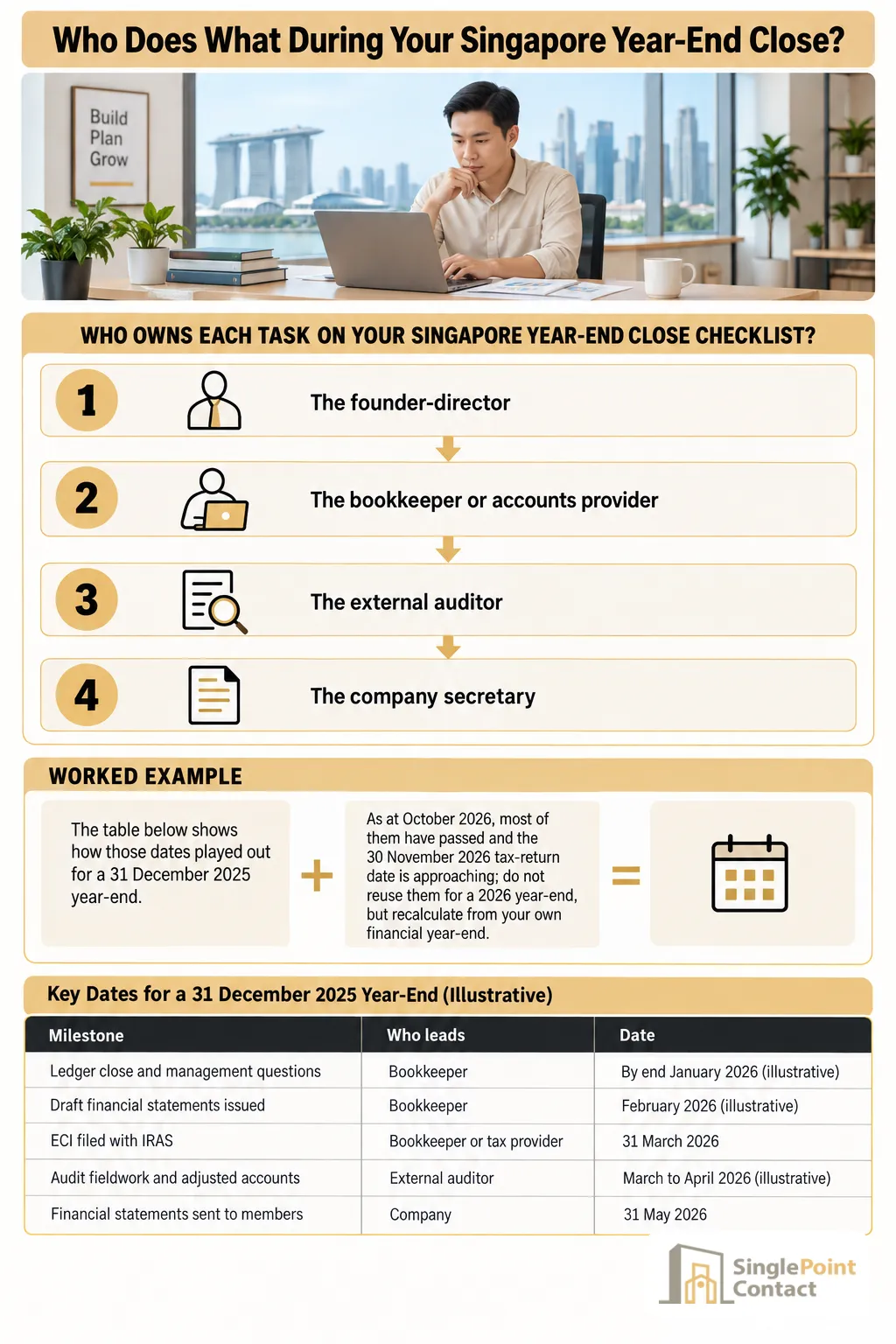
Year-End Responsibility Matrix for Singapore Companies
| Party | What they own |
|---|---|
| Founder-director | Supply complete records; explain unusual and related-party transactions; assess going concern and subsequent events; approve the accounts and statutory filings |
| Bookkeeper or accounts provider | Reconcile accounts; post cut-off and year-end adjustments; prepare schedules and the trial balance; compile draft financial statements |
| External auditor | Set audit scope independently; request evidence and confirmations; test balances; obtain management representations; issue the audit report |
| Company secretary | Confirm the AGM or exemption route; maintain statutory records; gather approved filing inputs; lodge the annual return through Bizfile |
What ACRA and IRAS deadlines do you work back from?
Work back from the fixed dates. The annual return is due within seven months of year-end for a non-listed company, unless it has share capital and an overseas branch register, in which case the deadline is eight months. Tax filings have their own calendar.
ACRA's rules state that all Singapore-incorporated companies must file an annual return with ACRA each year, and directors stay legally responsible for timely filing even when a secretary lodges it on the company's behalf.
For a private company using the AGM exemption, financial statements must be sent to members within five months of the financial year-end. Where an AGM is required, it must be held within six months. A non-listed company's annual return is due within seven months of year-end, unless it has share capital and an overseas branch register, in which case the deadline is eight months. These are statutory deadlines — recheck them against ACRA's current guidance before you plan, because rules can change.
On the tax side, the Estimated Chargeable Income (ECI) is generally due within three months of the financial year-end, unless the company qualifies for IRAS's ECI filing waiver. Waiver eligibility depends on IRAS's conditions, so check rather than assume. The corporate income tax return — Form C-S, Form C-S (Lite), Form C or, for a qualifying dormant company, the Form for Dormant Company — for the relevant Year of Assessment falls due on 30 November.
For planning, you could aim to close the ledger in January, issue draft accounts in February, run audit fieldwork through March and April, and reach approval in May for an audited company with a 31 December year-end. Treat that as an illustrative workback only, not a statutory timetable — your own audit timeline depends on management evidence, findings and signatures.
The table below shows how those dates played out for a 31 December 2025 year-end. As at October 2026, most of them have passed and the 30 November 2026 tax-return date is approaching; do not reuse them for a 2026 year-end, but recalculate from your own financial year-end.
Key Dates for a 31 December 2025 Year-End (Illustrative)
| Milestone | Who leads | Date |
|---|---|---|
| Ledger close and management questions | Bookkeeper | By end January 2026 (illustrative) |
| Draft financial statements issued | Bookkeeper | February 2026 (illustrative) |
| ECI filed with IRAS | Bookkeeper or tax provider | 31 March 2026 |
| Audit fieldwork and adjusted accounts | External auditor | March to April 2026 (illustrative) |
| Financial statements sent to members | Company | 31 May 2026 |
| AGM, where one is required | Company and secretary | 30 June 2026 |
| Annual return lodged via Bizfile | Company secretary | 31 July 2026 (or 31 August 2026 if the company has share capital and an overseas branch register) |
| Corporate income tax return (Form C-S or Form C) | Bookkeeper or accounts provider (if tax work is included) | 30 November 2026 |
How does an audit-exempt company's close differ?
Audit exemption removes the auditor from the process — not the accounts, the deadlines or the filings.
A private company may be exempt from audit if it meets ACRA's small-company criteria. Broadly, a private company qualifies as small if it meets at least two of these tests:
- Total annual revenue not more than S$10 million.
- Total assets not more than S$10 million.
- No more than 50 employees.
The company must pass at least two of these tests in each of the two preceding financial years. Separate group-level conditions can apply. Do not self-certify from an article; assess the company's full facts and group position with your officers.
Audit exemption does not remove these obligations:
- Keep proper accounting records.
- Prepare compliant financial statements.
- Meet the AGM or circulation rules.
- File the annual return.
Where applicable, annual-return filing includes financial statements in the required XBRL format or a PDF submission. Audit-exempt company accounts can be a misleading phrase. The accounts still exist and may feed the Singapore XBRL annual return.
Plan for the directors' statement early. A sole director signs for a one-director company. At least two directors sign where a company has multiple directors. Board, shareholder and tax approvals may carry their own requirements, so confirm each with your secretary.
What do the bookkeeper, auditor and secretary each request at year-end?
Three different packs, one set of records: the bookkeeper, the auditor and the secretary each request what their own stage requires.
Each party's request list reflects their role, so expect three overlapping but distinct packs. The list below is illustrative — it shows the kind of evidence each stage draws on, not our standard checklist or a complete audit request list.
The bookkeeper's pack is the widest, because everything downstream is built from it. The auditor's pack is narrower but deeper, and the auditor separately controls confirmations from banks, customers, suppliers and lawyers. The secretary's pack is the smallest. It still has to include:
- The approved financial statements.
- A signed directors' statement.
- A signed audit report where applicable.
- The AGM or circulation dates. The annual return's dates and financial figures must agree with the final accounts and corporate registers.
Who Needs What in the Year-End Document Pack
| Party | Typical items requested |
|---|---|
| Bookkeeper | Bank, card, loan, payment-gateway and investment statements; missing sales invoices and supplier bills; payroll and CPF records; GST returns; contracts for leases, loans and major sales; fixed-asset and inventory records; director-current-account, dividend and share-capital details; evidence for transactions just before and after year-end |
| External auditor | Final trial balance and general ledger; draft financial statements; lead schedules and reconciliations; aged listings; supporting samples; board or shareholder minutes — plus confirmations the auditor requests directly |
| Company secretary | Approved financial statements; signed directors' statement; signed audit report where applicable; AGM or circulation dates; proposed resolutions; XBRL data; confirmation of any changes to officers, shareholders, share capital or the registered office |
What usually holds up the close?
The blockers are rarely exotic accounting issues — they are ordinary records sitting with the wrong party at the wrong time.
Judging by how these handovers chain together, the items below are the ones that most obviously stall the next party. We describe them as patterns and plausible dependencies, not as measured causes across our client base.
1. One unreconciled account
A single unreconciled bank, payment-gateway or director-current account is enough. An auditor cannot rely on a trial balance where cash does not reconcile, opening balances moved without explanation, or revenue does not tie to the sales platform and GST returns.
2. Missing agreements and inventory evidence
A missing loan agreement stalls the split between principal, interest and current liabilities. A missing year-end inventory count stalls cost of sales and any audit observation work. Both are ordinary documents — they simply have to exist before the next stage can finish.
3. Moving inputs at the filing stage
The secretary is blocked by unsigned or unapproved financial statements, an outstanding audit report, incomplete XBRL data, or unconfirmed changes to officers, shareholders or the registered office. The annual return is not a standalone form: its dates and financial information must match the final accounts, so it cannot safely be filed while those inputs are still moving.
Can tax, XBRL and secretarial work run in parallel?
Yes — partly. Parallel work is safe once the trial balance is stable; final approval is not safe until material adjustments are resolved.
Once the trial balance is sufficiently stable, the tax computation, XBRL preparation and the secretary's review can proceed alongside one another. Final signing should wait until material adjustments are settled. This is a planning judgement, not a statutory sequence.
The ECI is a separate track. Where the engagement includes it, an ECI can be filed using a reasonable estimate based on the available records. That depends on records being good enough to support the estimate before the three-month deadline.
Year-end scope is modular. The engagement should state whether it includes financial-statement compilation, ECI or corporate-tax filing, XBRL preparation, or liaison with a company secretary. Confirm the scope and fees before relying on any of those services.
Conclusion
A Singapore year-end close checklist maps dependencies. Your records feed the ledger. The ledger feeds the accounts. The accounts feed audit work, tax filings and the annual return.
Before work starts, get the engagement scope in writing. It should state whether it covers:
- Bookkeeping
- Tax work
- Financial-statement compilation
- XBRL preparation
- Liaison with an auditor or company secretary
When you work with us, you'll have one point of contact from the first record request to the final filing. You won't be passed between several people. If you send a question through our online platform, your contact can respond quickly. That helps so a missing record does not stall the close longer than it needs to.
That scope list is a planning pointer, not a quote for our service scope. We'll confirm the exact responsibilities, communication arrangements and fees with you before any work starts.
If you would like help with your next year-end, contact us before the financial year-end. Earlier recordkeeping can make later handovers smoother.
Ready to hand over your year-end?
Tell us your financial year-end and ask what year-end support may be available.
Frequently Asked Questions
No. A private company that meets ACRA's small-company criteria can be exempt from audit, but it must still keep proper accounting records and prepare compliant financial statements for filing.
For most non-listed Singapore companies, it is within seven months of the financial year-end. Companies with share capital and an overseas branch register have eight months. Where an AGM is required, it must be held within six months, and a private company using the AGM exemption must send financial statements to members within five months.
Generally no. Unsigned financial statements, an outstanding audit report, incomplete XBRL data or unconfirmed corporate-record changes will hold up a safe filing, because the return must agree with the final accounts.
For a one-director company, the sole director signs. Where the company has multiple directors, at least two directors must sign. Other approvals may carry their own requirements.
Not usually. The ECI is generally due within three months of the financial year-end and can be filed on a supportable estimate, unless the company qualifies for IRAS's filing waiver.

Single Point Contact
Author
Single Point Contact Pte. Ltd. is a Singapore company providing bookkeeping, tax, GST and payroll services for start-ups and small businesses, run fully online with one dedicated point of contact for each client.