

How can you tell whether a Singapore tax provider will prepare your company's tax computation and handle IRAS queries — or simply submit a return? That question sits at the heart of comparing corporate tax filing services in Singapore. A quotation may leave that question unanswered, and price alone does not show who will handle a query.
The Inland Revenue Authority of Singapore (IRAS) generally sets 30 November 2026 as the Year of Assessment (YA) 2026 filing deadline, with an automatic extension to 15 December 2026 for eligible Form C-S returns filed through #SeamlessFilingFromSoftware. Waivers and applicable new-company exceptions may also affect filing obligations. Behind that single deadline sit schedules, adjustments, evidence and approvals. Scope decides who does that work: you, your bookkeeper or your provider.
Under IRAS rules, directors remain responsible for accurate, on-time filing even when a tax agent is engaged. Late or non-filing can draw penalties of up to S$5,000. Choosing a provider is therefore part of your own compliance duty, not a hand-off.
In this blog, we discuss what to check in a proposed corporate tax engagement, how a Singapore tax computation service should treat unreconciled books, and who should investigate ambiguous expenses and IRAS queries — so you can compare any quote with a practitioner's eye.
Table of Contents
What Should a Complete Corporate Tax Engagement in Singapore Cover?
In our team's professional judgement, a useful comparison goes beyond the submitted form: ask about the tax computation, supporting schedules, Estimated Chargeable Income (ECI), approval, filing and assessment review. This is comparison advice, not evidence that any provider includes these tasks. IRAS explains that a company must prepare a tax computation and supporting schedules before completing its corporate income tax return. The computation adjusts accounting profit to arrive at chargeable income, the amount of income assessed for tax. This company obligation does not establish that a provider prepares the documents within its fee.
The form you file depends on eligibility. For Form C, financial statements, the tax computation and supporting documents are generally submitted with the return. For Form C-S or Form C-S (Lite), they are generally prepared and retained for IRAS to request, though some declarations must be submitted with the return. For YA 2026, Form C-S (Lite) is open to Form C-S-eligible companies with annual revenue of S$200,000 or below, using six essential fields.
1. The tax computation and supporting schedules
This is where accounting profit is reconciled to chargeable income. Adjustments such as non-deductible expenditure, capital allowances and losses brought forward are shown and evidenced. Ask each provider whether preparing it, and the supporting schedules, sits inside the quoted fee or appears later as an extra.
2. The Estimated Chargeable Income filing
ECI is a separate obligation, generally due within three months of the financial year end unless the company qualifies for a waiver or is not required to file. The corporate income tax return does not replace it. Confirm in writing whether the ECI declaration is included, excluded or billed separately.
3. Your approval before anything is filed
In our team's judgement, a useful engagement control is for the provider to send the final computation, material schedules and a summary of the return for written approval before filing, highlighting judgement calls and the expected tax position. Agree who approves and how. This is a proposed control, not a universal IRAS requirement for a director to sign every computation or schedule.
4. Review of the Notice of Assessment
When the Notice of Assessment arrives, someone should compare it against what was filed. Differences are far easier to query early. Ask who does that review and whether it sits inside the fee.
How Do You Compare Corporate Tax Service Providers in Practice?
You work through five questions about who actually does the work. We help Singapore founders and small businesses with corporate tax, and these are the questions we would put to any provider first. Each question helps you identify boundaries that a filing-only quote may leave open.
A Singapore corporate tax service comparison should establish those boundaries before you sign. Ask each provider to confirm in writing who prepares and files each document, investigates questions, makes corrections, obtains approval, reviews the assessment and monitors and answers IRAS correspondence. Compare the fee, exclusions, extra-work charging basis, expected response times and coverage period. Ask whether you will receive the approved computation, schedules and filing acknowledgement, and how approval works for ECI or a material amendment. These are comparison questions, not evidence of what a particular provider includes; the signed terms determine the allocation.
1. Who prepares the computation and schedules?
If the answer is 'you do' or 'that is extra', the engagement is narrower than it looks. The computation is where adjustments, capital allowances and losses are argued and evidenced, so it should not be an afterthought.
2. Who investigates bookkeeping questions?
Ambiguous expenses and unsupported payments can require further investigation. Decide upfront whether the provider investigates them or simply sends them back to you.
3. Who obtains approval and files?
IRAS requires the person filing the return electronically to have the relevant Corppass authorisation. Your written approval of the computation is an engagement control that sits alongside the electronic declaration.
4. Who responds to IRAS?
Post-filing letters may be addressed to the company or its tax agent, so agree who will monitor and respond to them. Agree which routine IRAS queries the provider handles within its fee, and what triggers a separate quote.
5. Who is accountable for deadlines?
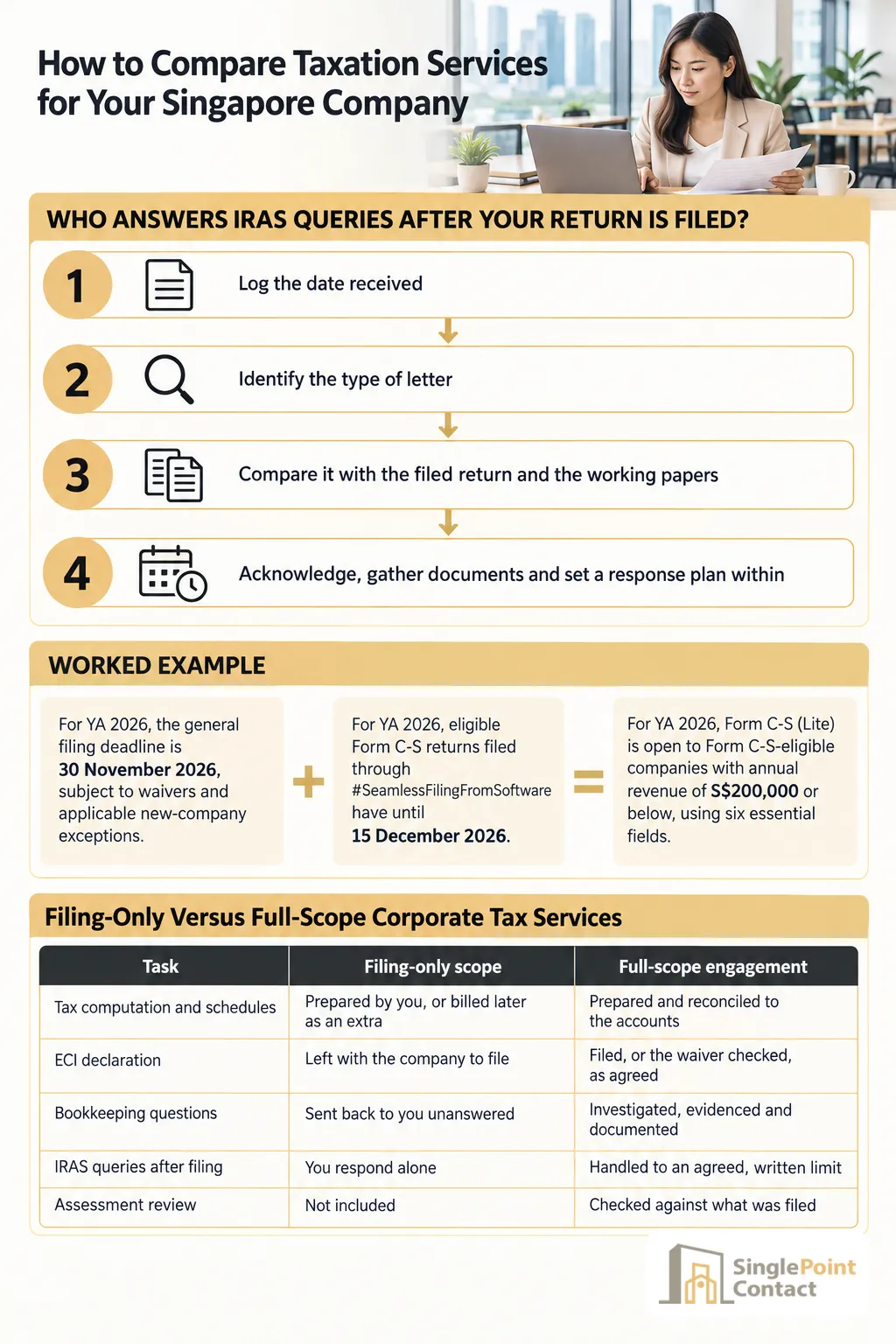
IRAS reminds directors that they remain responsible for accurate, on-time filing even when a tax agent is engaged. For YA 2026, the general filing deadline is 30 November 2026, subject to waivers and applicable new-company exceptions; eligible Form C-S returns filed through #SeamlessFilingFromSoftware have until 15 December 2026.
Filing-Only Versus Full-Scope Corporate Tax Services
| Task | Filing-only scope | Full-scope engagement |
|---|---|---|
| Tax computation and schedules | Prepared by you, or billed later as an extra | Prepared and reconciled to the accounts |
| ECI declaration | Left with the company to file | Filed, or the waiver checked, as agreed |
| Bookkeeping questions | Sent back to you unanswered | Investigated, evidenced and documented |
| IRAS queries after filing | You respond alone | Handled to an agreed, written limit |
| Assessment review | Not included | Checked against what was filed |
How Do You Judge a Singapore Tax Computation Service?
Judge it by what it asks for before it quotes. In our team's judgement, a profit-and-loss PDF alone does not provide enough detail to investigate the underlying numbers. Ask what records the preparer needs and what checks the quoted work includes. The handover may include unaudited financial statements.
1. The year-end handover
Expect a request for the final trial balance and the detailed general ledger, plus the financial statements, bank reconciliations, receivables and payables listings and the fixed-asset register. Loan and director-account schedules, payroll summaries and Goods and Services Tax (GST) reconciliations should follow, together with the prior-year computation and assessment, relevant capital-allowance and loss schedules, and source records for material or unusual transactions. Access to Xero helps, but it does not replace a clear handover. The table below lists the core set we would ask for.
2. First checks on the numbers
Drawing on our team's professional experience, we would first check that opening balances agree to the prior year's closing records. The trial balance should agree to the financial statements, and control accounts, the ledger totals summarising balances such as receivables or payables, should agree with their detailed listings. Anything unresolved should return to you and your bookkeeper as a numbered exception list, not as a vague worry.
3. Who fixes an unreconciled difference
Settle the division of work before filing season. One possible arrangement is for the external bookkeeper to make agreed accounting corrections while the tax preparer identifies the tax implications and re-checks the revised balances. If the bookkeeper or client has not agreed to that work, decide who will handle it and obtain a quote before proceeding. An unreconciled accounting difference should never be quietly buried inside a tax adjustment. If you outsource bookkeeping services, decide who fixes exceptions and how that work is charged.
Year-End Documents a Tax Preparer Should Request
| Document | Why it matters |
|---|---|
| Final trial balance and general ledger | The basis for every tax adjustment |
| Financial statements | The computation must reconcile to them |
| Bank reconciliations | Confirms cash movements are complete |
| Receivables and payables listings | Tests revenue and expense cut-off |
| Fixed-asset register | Supports capital allowances and disposals |
| Loan and director-account schedules | Explains balances that often adjust tax |
| Payroll summaries and GST reconciliations | Ties the ledger to other statutory filings |
| Prior-year computation and assessment | Carries forward losses and allowances |
How Should an Ambiguous Expense Be Investigated Before Filing?
Investigate the facts first, because deductibility depends on them and on the applicable tax rules, not on the ledger label. IRAS lists personal expenses among the items that are not deductible. The example below is expressly hypothetical: it is a possible division of work to test with a provider, not a client record or Single Point Contact's confirmed workflow.
1. An illustrative director's flight
Picture a flight booked through the company that turns out to include a director's personal travel. A receipt proves a purchase; it does not prove a business purpose. The client would supply the facts, while the tax preparer could assess the treatment using those facts and the applicable rules.
2. The questions and evidence that settle it
The preparer should establish who travelled, the business purpose, the itinerary, who was met and whether there was a private extension. Who ultimately bears the cost, and whether reimbursement is expected, matter just as much. Useful evidence includes the booking invoice, payment proof and business correspondence such as meeting confirmations.
If the trip was personal and repayable, an external bookkeeper could reclassify it to the director's account and document the conclusion, provided that responsibility has been agreed. The tax preparer could then check the revised ledger and prepare the computation and schedules for client approval. If the bookkeeper or client has not agreed to those responsibilities, settle who will do the work and its cost before proceeding. If the company bears the cost as remuneration or a benefit, the deduction and reporting treatment need their own analysis. In our view, a travel label in the ledger does not decide tax treatment.
3. Where the record should sit
In our team's judgement, the facts, evidence, decision and any journal reference should be recorded in tax working papers linked to the ledger entry. Agree who keeps those records; this does not describe Single Point Contact's confirmed storage process. Quick messages are convenient for collecting an explanation, but they must not be the only place a conclusion survives. For a payment with no invoice, seek a duplicate or other contemporaneous evidence identifying the supplier, the purchase and the business purpose. An unclear business purpose, a possible personal element or uncertainty about whether a purchase is capital or revenue expenditure can require further questions before treatment is settled. A bank debit alone does not establish deductibility.
Who Answers IRAS Queries After Your Return Is Filed?
Whoever your engagement says answers them, which is why you should settle it before the return goes in. Appointing a tax agent does not mean the company can ignore correspondence addressed to it. Forward notices immediately and follow a simple sequence:
- Log the date received, the stated deadline and the person responsible.
- Identify the type of letter: information request, assessment, payment notice or investigation.
- Compare it with the filed return and the working papers.
- Acknowledge, gather documents and set a response plan within the deadline.
1. Information requests and routine clarifications
Supplying an existing schedule or explaining an adjustment is routine work. A quote may include or exclude such work, so ask for its limits, coverage period and expected response times in writing. Be wary of open-ended 'IRAS support' promises. A serious quote states what is included and what is quoted separately.
2. Assessments, payment notices and investigations
These letters carry their own deadlines and consequences. Substantial work, such as reconstructing missing records, reviewing additional years or handling an investigation, may require a separate quote. Ask where correction of a provider's own filing error sits. Our view is that it should not attract an extra professional fee.
3. Objections and their deadlines
IRAS states that a notice of objection to a corporate income tax assessment generally must be filed within two months of service and state precise grounds. An informal exchange of messages is not a substitute. Check the notice and applicable procedure, including whether a different procedure applies to an ECI assessment. IRAS may consider an extension case by case; its guide says to request one within the objection period. Confirm whether preparing an objection is in scope or a separate engagement.
Where Does a Small-Company Tax Service Stop Fitting?
It stops where the written scope stops, which is why exclusions belong in the quotation. Boundaries discovered after filing can cause friction if everyone assumed someone else was doing the work. For example, confirm whether compilation of financial statements is included.
1. Work that may be scoped separately
Audits, company-secretary annual-return work, bookkeeping reconstruction, prior-year corrections, objections, investigations, transfer-pricing documentation and specialist cross-border advice may be scoped separately. Compilation of financial statements can also be a separate service. Ask each one to list exclusions beside inclusions, not in the small print. The table below lists examples to confirm; it does not establish any provider's exclusions or charging policy.
2. When a specialist fits better
If your main need is specialist tax advice, weigh a specialist-led arrangement. Examples include substantial transfer-pricing work, complex international structuring, a major acquisition or an active investigation. A dedicated point of contact who organises accounting information well is not a substitute for specialist capability, though the two can work side by side.
3. When in-house finance makes sense
Businesses needing daily on-site finance management, complex consolidation or an internal financial controller may be better served by an in-house team, with external tax support alongside. An online back-office model may suit a business that does not need an on-site finance function. If a provider cannot state where it stops, treat that as an answer — and feel free to contact us to ask where ours does.
Work Usually Priced Separately from Corporate Tax
| Item | Why it is separate | What to confirm |
|---|---|---|
| Audit | Regulated work for a licensed auditor | Who liaises and who pays |
| Company-secretary annual return | A distinct statutory role | Who coordinates the filing |
| Bookkeeping reconstruction | Accounting work, not tax computation | Hourly or fixed fee |
| Prior-year corrections | Opens earlier years for review | Who approves and files amendments |
| Objections and investigations | Substantive representation | Handled in-house or referred |
| Transfer-pricing documentation | Documentation supporting related-party pricing, including where applicable domestic transactions | Who prepares it and whether a specialist is needed |
| Compilation of financial statements | A separate deliverable from the computation | Bundled or priced alone |
How Do Written Boundaries Protect You at Single Point Contact?
They make the advertised package and the tax engagement two clear things instead of one blurry promise. Our daily bookkeeping package advertises a dedicated finance specialist, WhatsApp communication, Xero and liaison with your auditor and company secretary for the annual return. Those are bookkeeping-package features.
Our taxation page lists corporate income tax services, and our pricing page lists taxation as a separately priced bookkeeping add-on. These pages describe advertised services, not the detailed scope of a signed corporate-tax engagement or services actually delivered to a client. The bookkeeping features above are not necessarily included in a standalone tax engagement; check the signed terms. We say that plainly because a quotation you can test is worth more than a promise you cannot. Ask us what sits inside the corporate tax fee and what is quoted separately, and we will answer in writing.
1. What the bookkeeping package covers
Daily bookkeeping on Xero, one dedicated point of contact and coordination with your own auditor and company secretary for the annual return. These are advertised bookkeeping-package features, not confirmation that they are included in a standalone tax engagement.
2. What the tax engagement should state
The computation and schedules, the ECI position, your approval step, the filing itself and the treatment of IRAS correspondence. Every one of those points belongs in the engagement terms you actually sign.
Conclusion
Comparing taxation services comes down to scope, not slogans. Ask who prepares the computation and schedules, who investigates bookkeeping questions, who obtains your approval, who files, and who answers IRAS. Then get every boundary in writing before you sign anything.
Our published daily bookkeeping package advertises a dedicated finance specialist, WhatsApp communication, Xero and liaison with the auditor and company secretary for the annual return. Taxation is listed as a separately priced add-on. These advertised features do not establish the scope or delivery of a particular corporate-tax engagement, so ask us to confirm the details in writing.
If you are comparing corporate tax filing services in Singapore, put these questions to every provider on your list — including us. Ask what sits inside the fee, what is quoted separately, and who picks up the conversation when IRAS writes.
Compare the Scope Before You Sign
Send us your questions about corporate tax scope and we will walk you through what a well-drafted engagement should cover for your Singapore company.
Frequently Asked Questions
A company must prepare a tax computation and supporting schedules before completing its return. For Form C, financial statements and the computation are generally submitted with the return; for Form C-S or Form C-S (Lite), they are prepared and retained for IRAS to request. For YA 2026, the general filing deadline is 30 November 2026, subject to waivers and applicable new-company exceptions; eligible Form C-S returns filed through #SeamlessFilingFromSoftware have until 15 December 2026. Some declarations or other documents have different submission requirements, and form eligibility depends on the company's circumstances. The company's preparation obligation does not establish that a provider includes the work in its fee.
No. Estimated Chargeable Income (ECI) is a separate filing, generally due within three months of the financial year end unless the company qualifies for a waiver or is not required to file. Confirm in writing whether your provider includes it.
No. IRAS requires companies to retain source documents and accounting records and to be able to explain their transactions, and treats bank statements alone as insufficient. Keep invoices, contracts and other contemporaneous evidence.
Yes. IRAS states that directors remain responsible for accurate, on-time filing even when a tax agent is engaged, and late or non-filing can attract penalties of up to S$5,000. The person filing also needs the relevant Corppass authorisation.
A notice of objection generally must be filed within two months of service of the assessment and state precise grounds. IRAS may consider extensions case by case; its guide says to request one within the objection period. Check the notice and applicable procedure early, including for an ECI assessment. Confirm with your provider whether preparing an objection is in scope.

Single Point Contact
Author
Single Point Contact Pte. Ltd. is a Singapore company providing bookkeeping, tax, GST and payroll services for start-ups and small businesses, run fully online with one dedicated point of contact for each client.