
How can you tell whether someone can handle your actual accounts before you commit? To compare online bookkeeping services in Singapore, our team suggests giving each provider the same representative sample month of Xero work and judging the entries, questions and reports.
This is a suggested exercise, not a confirmed Single Point Contact process; agree its scope with a practitioner first. According to ACRA, directors remain legally responsible for their company's financial statements even when preparation is outsourced. A Goods and Services Tax (GST) error may surface months later, after a return has been filed and the cash has been spent.
A sample test can reveal issues before you commit, but it cannot guarantee compliance. The provider's response can also help you assess how it handles questions.
In this blog, we discuss what a fair test looks like, what to send, what should come back, which decisions stay yours, and how to score providers on demonstrated work rather than promises.
Table of Contents
Why Test a Xero Bookkeeping Service Before You Sign Up?
Anyone can write accurate, daily and hassle-free on a website. A test asks a provider to demonstrate the same claims inside Xero, before money changes hands. That is how we believe any provider, including us, should be judged.
The stakes are real. Guidance from the Accounting and Corporate Regulatory Authority (ACRA) is clear that directors remain legally responsible for their company's financial statements even when preparation is outsourced. Every Singapore-incorporated company must also file annual returns with ACRA to keep its records current.
So testing protects you, not just your budget. Bookkeeping errors surface months later, when a return has been filed and the money is spent. A sample month surfaces them in days.
In practice, we run our bookkeeping services this way: one dedicated point of contact, quick replies over WhatsApp, and daily entries on Xero. The test below reflects how we think every provider should be evaluated.
What Should a Sample Test Month Contain?
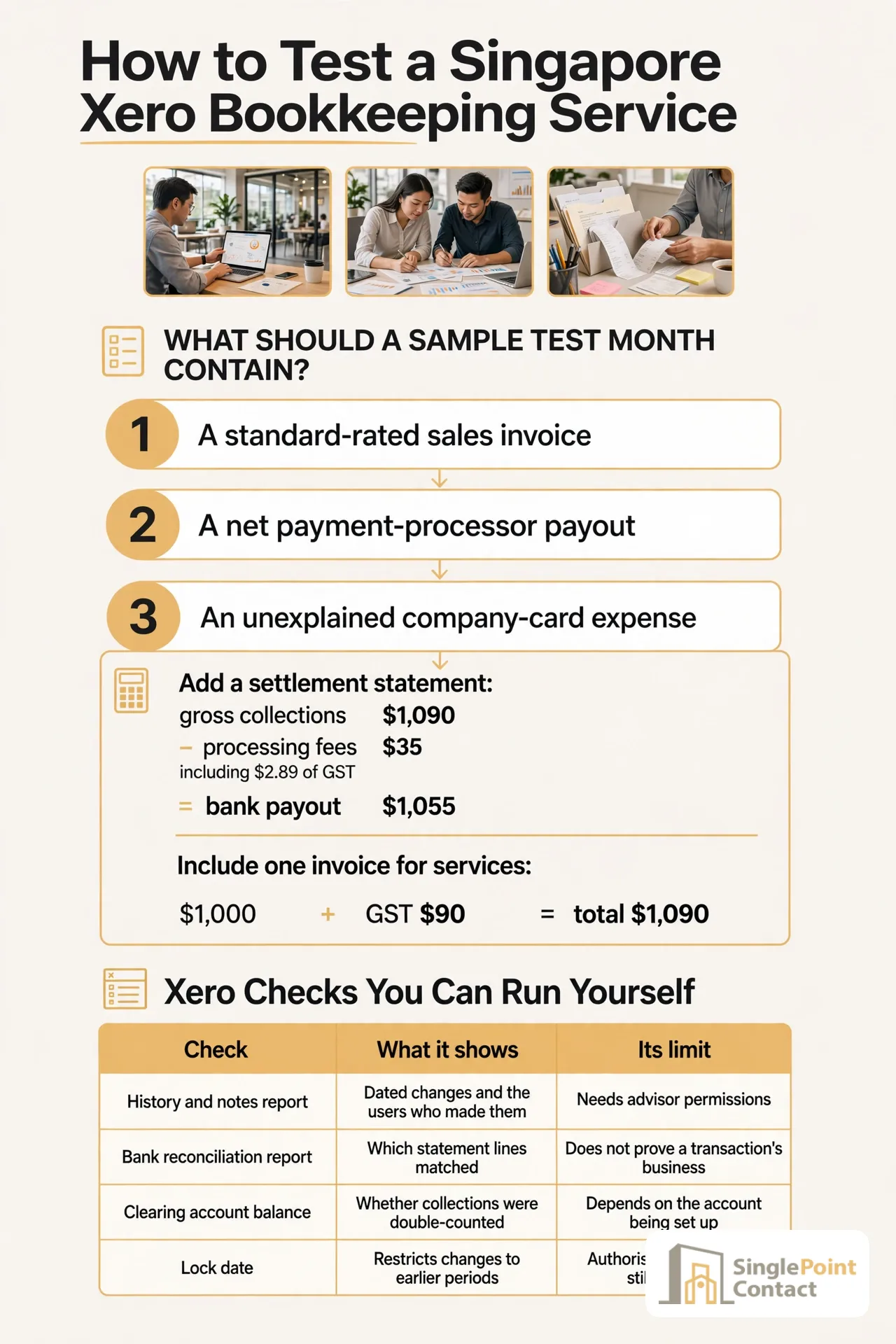
Build a small, clearly fictional pack for one typical month, and send the identical files to every shortlisted provider. This is a suggested evaluation exercise rather than a documented process of any one firm, so agree the scope with your practitioner first. Three items are usually enough to show how a provider thinks.
All figures below are illustrative. The fictional company makes only standard-rated Singapore supplies and has no opening balances. Real transactions need proper classification, and a real GST return covers the whole applicable accounting period.
1. A standard-rated sales invoice
Include one invoice for services of $1,000 plus GST of $90, total $1,090. According to the Inland Revenue Authority of Singapore (IRAS), the prevailing GST rate for standard-rated supplies is 9%. This item tests whether the provider splits sales, output tax and receivables correctly.
2. A net payment-processor payout
Add a settlement statement: gross collections of $1,090, processing fees of $35 including $2.89 of GST, and a bank payout of $1,055. The payout settles the sample invoice; it is not a second sale. This tests whether the provider records gross sales and a separate fee, or wrongly books the net payout as revenue.
3. An unexplained company-card expense
Finish with a card statement showing a $60 ride-hailing charge with no receipt or explanation. This tests exception handling: does the provider ask, guess, or quietly code it as travel?
Sample-Month Test: Weak vs Strong Responses
| Test element | Weak response | Strong response |
|---|---|---|
| Sales invoice with 9% GST | One net figure posted to sales | Sales $1,000 and output GST $90 split correctly; receivable $1,090 tracked |
| Net processor payout | Net bank line booked as revenue | Gross sales recorded; fee expensed separately; payout matched via a clearing account that ends at zero |
| Unexplained card expense | Coded as travel with no question | Held in suspense with no GST claim; numbered questions sent to the founder |
| Mini month-end report | Missing, or unrelated to the ledger | Revenue, expenses, balances, open exception and provisional GST position, all tied to the ledger |
What Should Come Back From the Test?
Ask each provider to return the postings, the reconciliation evidence, a list of flagged questions, and a short report. Everything returned should be labelled provisional and illustrative, not a closed month or a filed return.
What separates a strong return from a weak one is traceability. You should be able to follow each figure back to a source document.
1. Coded and reconciled entries
A strong response debits receivables $1,090 and credits sales $1,000 with output GST of $90. It matches the $1,055 payout to the settlement through a clearing account, not to a new sale. Both the clearing account and receivables finish at zero.
2. A numbered exception list
The card charge should sit in a suspense account with no GST claim. You should see numbered questions: who travelled, for what business purpose, where is the receipt, and was any part personal. Nothing should be classified before you answer.
3. A provisional mini report
The report should show revenue, expenses, a provisional profit, bank and card balances, the unresolved item, and a provisional GST position. It must say clearly that the GST figure covers this sample activity only. A real return covers the applicable accounting period and all relevant transactions.
Which Decisions Stay Yours and Which Belong to the Bookkeeper?
Good bookkeepers separate facts from rules. You supply the facts: who travelled, whether the trip was partly personal, and whether you will reimburse the company. The provider applies the rules.
IRAS lists conditions for claiming input tax, and a tax invoice alone is not sufficient; a genuine qualifying business transaction is also required. The sample fee is fictional, so do not assume a real processor fee always bears claimable Singapore GST.
Written approval cannot make an unsupported claim valid. A provider who treats your sign-off as authority for a GST claim is a red flag. Approvals belong around material judgements instead, such as expensing versus capitalising a piece of equipment.
If you are not on the register yet, our guide on whether you need to register for GST in Singapore covers the thresholds and the steps.
Xero Checks You Can Run Yourself
| Check | What it shows | Its limit |
|---|---|---|
| History and notes report | Dated changes and the users who made them | Needs advisor permissions; excludes some activity |
| Bank reconciliation report | Which statement lines matched to which entries | Does not prove a transaction's business purpose |
| Clearing account balance | Whether collections were double-counted | Depends on the account being set up correctly |
| Lock date | Restricts changes to earlier periods | Authorised advisors can still change it |
What Can You Check Yourself in Xero Afterwards?
Once the test month comes back, open Xero and inspect the work yourself. Xero's product documentation describes tools that make this possible, each with limits you should know about.
- The History and notes report shows dated changes and which users made them. It needs advisor-level permissions and excludes some activity.
- A bank reconciliation report shows which statement lines were matched, and to what.
- The clearing account balance confirms collections were not double-counted.
- Linked documents show each entry is tied to its source.
- A lock date restricts changes to earlier periods. Authorised advisors can still change it, so treat it as a control, not a seal.
None of these checks proves a transaction's underlying business purpose. That is what the exception list and reviewer questions are for. If you can, also ask who coded the entries and who reviewed them before anything was sent back.
How Do You Score Shortlisted Providers Fairly?
For a fair comparison of online bookkeeping services in Singapore, give every provider the same pack, the same time allowance, and the same chance to ask questions. Any scoring sheet is a suggestion to agree with your practitioner, not a validated standard. The principle still holds: credit only what is demonstrated.
Compare demonstrated execution, fees, scope and support separately. Fees matter, but price alone earns no execution points. Our guide on how much monthly bookkeeping costs in Singapore explains what a monthly fee should cover.
1. What earns execution credit
Credit comes from work you can see: output GST shown separately from sales, supported input tax rather than one net figure, a reconciliation with no duplicate sales, and a report that ties to the ledger. Traceable entries and a named owner count as well.
2. What should fail the test
Claiming GST on the unsupported card charge, treating the net payout as gross sales, or quietly writing off a reconciliation difference should fail regardless of presentation. So should classifying the card charge without asking you first.
3. Over-promises to probe
The claim we would probe hardest is daily. Does it mean someone checks incoming information each working day, or that every balance is final each evening? Those are different services. Routine GST coding also does not demonstrate cross-border or reverse-charge expertise. If broader tax help matters, our guide to comparing taxation services in Singapore is a separate decision worth its own test.
Questions to Ask Before You Sign Up
| Question | Why it matters |
|---|---|
| What does daily bookkeeping mean in practice? | Daily checks and final nightly balances are different services |
| Who codes my entries, and who reviews them? | You want a named owner plus a second pair of eyes on month-end work |
| What pauses the monthly close? | Missing answers from you should pause the clock; silence should not |
| What sits outside the scope? | Audit and company-secretary work stay with your own professionals |
| What happens if I disagree with a GST call? | A good provider explains the rule rather than deferring to you |
What Are the Limits of a Sample-Month Test?
A clean sample month is a good sign, not a guarantee. It cannot establish year-end quality, how a provider handles an IRAS query, who covers the work when your contact is on leave, or how the service copes with higher volumes.
It also cannot show the full shape of a year. Audit and company-secretarial work sit outside bookkeeping: we prepare the accounting records and liaise with your own auditor and company secretary, who keep their own responsibilities.
When you compare offers, check what sits inside the monthly fee and what is a top-up. Our pricing page lists what our daily bookkeeping package includes and what is billed separately, such as quarterly GST submission. If anything is unclear, contact us before you commit.
Conclusion
Testing a bookkeeping provider comes down to one idea: judge demonstrated work, not promises. Send the same clearly fictional sample month to every shortlisted firm. Then compare the postings, the questions asked, the exceptions left open, and the report you receive.
Our published daily bookkeeping package lists Xero, a dedicated finance specialist and WhatsApp communication. Quarterly GST submission is listed as a separate top-up; confirm the current scope and terms before engaging us.
If you want to discuss your bookkeeping needs or ask whether a sample-month exercise can be agreed, contact us.
Put a Xero Bookkeeper to the Test
Send us your questions about our bookkeeping process, or ask us to walk through how we would handle a sample month of your transactions.
Frequently Asked Questions
As an illustrative planning estimate, allow around three working days after a provider receives a complete pack. This is not a confirmed turnaround; agree the schedule with each provider in advance.
Prefer a separate trial organisation with imported sample statement lines. If a provider must review your live books, agree confidentiality and scope first, keep it a review with no changes, and never share passwords.
No. IRAS conditions for input-tax claims must be met, and the transaction must be a genuine qualifying one. Your approval records a business decision; it does not make an unsupported claim valid.
Ask the provider directly. It may mean checking incoming information each working day, or that every balance is final each evening. Request transaction dates, posting dates, and the ageing of unanswered questions.
No. A sample month shows day-to-day quality. It cannot show year-end handling, responses to IRAS queries, or how the provider copes with growth, so keep reviewing after you sign up.

Single Point Contact
Author
Single Point Contact Pte. Ltd. is a Singapore company providing bookkeeping, tax, GST and payroll services for start-ups and small businesses, run fully online with one dedicated point of contact for each client.